A concentration game in disguise
NEON HOLD
Most people break inside twenty seconds.
Put your thumb on the spot. Keep it there. That is the entire game, and it is harder than it sounds, because every second you hold is a second of unbroken attention and the grid spends all of them trying to take it back. The spot relocates and you have to slide fast. Near-perfect decoys appear beside the real thing. GLITCH, a lying neon imp in increasingly desperate disguises, talks you into fatal mistakes. NOVA never lies.
iPhone, iOS 17 and later. Free with optional revive packs.
The loop, in one picture
The bar fills for as long as the thumb stays on the spot. It goes back to zero the instant it lifts. There is no pause, no checkpoint and no partial credit, and that is the whole design.
0s5s10s20s
Twenty seconds is where most people are already gone.
In the game the spot also moves, the decoys arrive, and something is talking to you the whole time.
What a run actually looks like
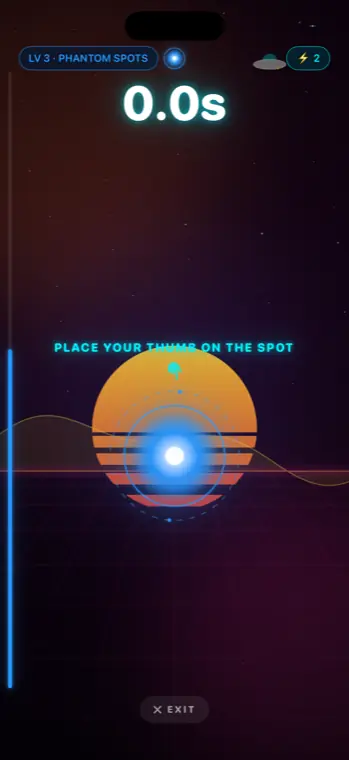
Thumb down, clock at zero. It only runs while you are exactly where you belong. 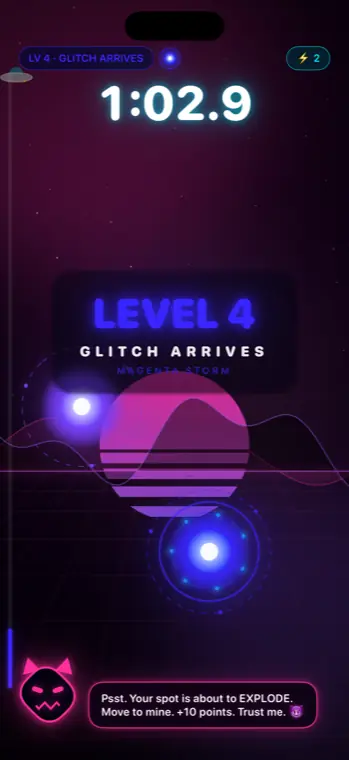
A minute in, GLITCH says your spot is about to explode. Move and the run is over. 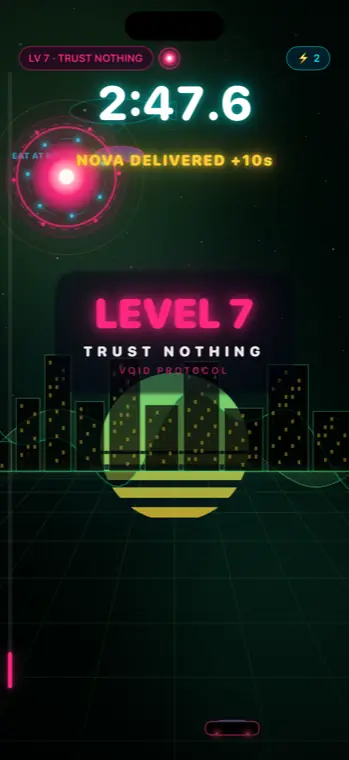
NOVA hands over ten free seconds. NOVA never lies. Telling them apart is the skill. 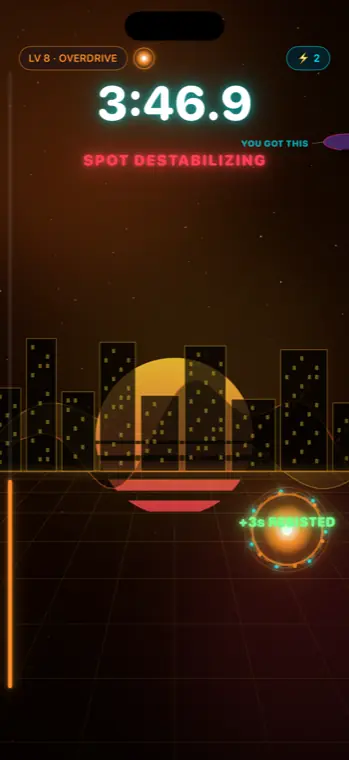
Level 8. The spot is destabilising and the sky is on fire. Three more seconds resisted. 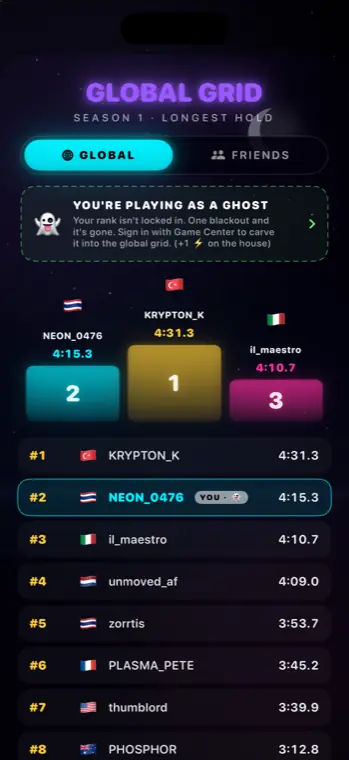
Second in the world, by sixteen seconds. That gap is the reason for the next run. 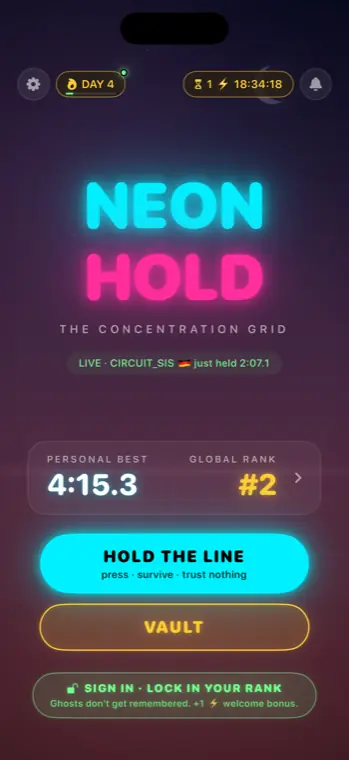
Day four of the streak, and a rank worth defending. Then back in, because you can do better.
Swipe for more
Anatomy of a run
- 0:00. Thumb down. The countdown runs while you hold, and it is the easiest the game will ever be.
- 0:07. The spot relocates. You have about three seconds to get there, and that window shrinks every level.
- 0:12. A decoy appears half an inch away, a shade off the real hue. Press it and the run is over.
- 0:16. GLITCH arrives dressed as the pause button and tells you it is safe to let go.
- 0:19. You believe it.
Concentration, disguised as a nerve game
Focus apps ask you to sit still and be good. NEON HOLD asks for the same thing and then makes you want to do it again. Three habits get exercised every run, whether or not you notice.
Sustained attention
One target, no pauses, no autopilot. The clock only counts while your thumb is exactly where it belongs, so the moment your mind wanders the score tells you.
Distraction resistance
A crowd swells, fireworks go up, a city closes in, and deep in a run the whole grid comes apart around your thumb. None of it matters. All of it pulls.
Impulse control
GLITCH lies. NOVA never does. Telling them apart with your run on the line is the same muscle that stops you opening a new tab mid sentence.
What the research actually says
Attention is one of the most studied things in psychology, and the honest summary is narrower than the one this category usually sells. Here is what the evidence supports, with the papers attached.
Sustained attention is a real, measurable ability, not a mood. Researchers have mapped it across more than ten thousand people, and it is distinct from general intelligence.
Fortenbaugh et al. (2015). Sustained Attention Across the Life Span in a Sample of 10,000. Psychological Science, 26(9), 1497 to 1510. doi.org/10.1177/0956797615594896Your focus fades the longer you hold it. That is not a personal failing, it is one of the most reliable findings in attention research, and it is measured with a task that asks you to stay on target while distraction competes for you.
Rosenberg et al. (2013). Sustaining visual attention in the face of distraction. Attention, Perception, & Psychophysics, 75(3), 426 to 439. doi.org/10.3758/s13414-012-0413-xThe brain learns to tune out a repeated distraction startlingly fast. Three replications across two labs found the filtering starts after only two or three encounters with it.
Savelson et al. (2025). Learned distractor rejection: Robust but surprisingly rapid. Attention, Perception, & Psychophysics, 87(4), 1132 to 1149. doi.org/10.3758/s13414-025-03051-4It also learns where distractions tend to come from and suppresses those places before anything appears there, and that suppression outlasts the training it came from.
Britton & Anderson (2020). Specificity and persistence of statistical learning in distractor suppression. Journal of Experimental Psychology: Human Perception and Performance, 46(3), 324 to 334. doi.org/10.1037/xhp0000718Attentional tracking genuinely improves with practice. In one controlled study, adults averaging 67 years old improved just as much as adults averaging 24.
Legault, Allard & Faubert (2013). Healthy Older Observers Show Equivalent Perceptual-Cognitive Training Benefits to Young Adults for Multiple Object Tracking. Frontiers in Psychology, 4, 323. doi.org/10.3389/fpsyg.2013.00323And what it does not say. The most thorough review of brain training found "extensive evidence that brain-training interventions improve performance on the trained tasks, less evidence that such interventions improve performance on closely related tasks, and little evidence that training enhances performance on distantly related tasks or that training improves everyday cognitive performance". A later meta-analysis of meta-analyses found that once placebo effects and publication bias are controlled for, far transfer is zero. So: NEON HOLD will make you better at NEON HOLD, and it is built out of the same ingredients researchers use to measure attention. It will not make you smarter, it is not therapy, it treats nothing, and no study has ever tested this game. Anybody telling you otherwise about their app is selling you something.
Simons et al. (2016), Psychological Science in the Public Interest, 17(3), 103 to 186, doi.org/10.1177/1529100616661983. Sala et al. (2019), Collabra: Psychology, 5(1), 18, doi.org/10.1525/collabra.203.
What ends a run
You lift off
The clock stops the instant your thumb leaves the glass. There is no pause and there never will be.
You drift
Past the edge of the spot is off the spot. It shrinks as the levels climb.
You get fooled
A decoy, a lie from GLITCH, or a relocation you reached a heartbeat too late.
Your best time is your name on the global grid. Nothing else counts.
A world that comes alive
Twenty levels, each with its own weather: midnight violet, teal dusk, sunset strip, electric city, inferno, and beyond. Every one of them has a sunrise, a daytime, a sunset and a night version, so a long run visibly travels through a whole day. Mountains rise. A scanlined sun climbs. A city grows closer the longer you hold. A blimp tows ridiculous banners and something in the dark occasionally blinks at you. An announcer with many voices calls your run out loud, and a synthwave soundtrack builds layer by layer as the grid heats up, then breathes when you rest.
The global grid
Climb a live world leaderboard and defend your rank. Get warned when a rival closes in. Add friends by code and race them on their own board. Game Center is optional: sign in to lock your name in, or do not, and your scores still count on the grid either way.
Fair by design
- One free revive every 24 hours. It does not stack, so use it or lose it.
- Daily streaks pay bonus revives on days 3, 5, 7, 10, 14, 21 and 30, then every tenth day after that.
- Invite a friend with your code and you both get 5 revives. Ten rewards a week, and they reset every week.
- Revives are capped at three per run, the same for everyone, so skill decides the board and money never does.
No ads. No tracking. No account required.
There is no account and no sign up, and there is no third party analytics or advertising SDK anywhere in the app. Play on your own and nothing is sent to us at all: every level works with the network off.
The global grid is the one thing that sends anything, and it is opt in. Signing in to Game Center is the switch: until you do, your times stay on your phone. Sign in and it publishes a display name, a country flag and a best score, tied to a random id your phone makes at first launch, never to your Apple ID or any advertising identifier. Invites are a code and the iOS share sheet, so there is no address to collect and none is ever asked for. The server that runs all of this holds no secrets at all, because it has nothing to authenticate to.
That is the whole of it, field by field, in the privacy policy. You can erase everything from inside the app, in one tap, without asking us.
- 20levels, each with four times of day
- 0trackers, analytics or ad SDKs
- 1developer, whose email goes straight to a person
Questions people actually ask
My run ended and I never lifted my thumb. What happened?
One of three things. The spot relocated and you got there too late, you drifted past its edge, or you followed a decoy. GLITCH will happily tell you the wrong one is real. NOVA never lies, so when the two of them disagree, believe NOVA.
Do I have to sign in to Game Center?
No. It is entirely optional and NEON HOLD never signs you in on its own. Sign in and your rank is locked to your Game Center name; skip it and your scores still count on the NEON HOLD grid. You can turn it off again in Settings, which stops the game using Game Center. Signing out of Game Center itself is done in the iOS Settings app, because no app can do that for you.
Can I redeem a second code from another friend?
No. An invite is a welcome for arriving, so it is one per player, for life. You can still add each other from the Friends tab, which needs no code at all.
What data do you collect?
Nothing that identifies you, and nothing at all until you ask for it. The game needs no account, and playing on your own sends us nothing. The global grid is opt in, and the switch is signing in to Game Center: doing so publishes a display name, a country flag and a best score against a random per install id. Invites are a code and the iOS share sheet, so we never see an email address or a contact list. You can erase all of it from inside the app.
More of them on the support page.
Who made this
I am Jan Rohweder, and I built NEON HOLD on my own. I wanted a focus trainer I would actually open, which ruled out every focus trainer I had ever downloaded, so I made the version that is fun to lose at.
nova@neonhold.com reaches me, not a helpdesk. If something is broken or unfair, say so and I will fix it.
How long can you hold on?